



By Leah Crane
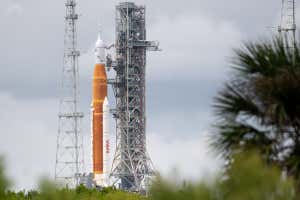
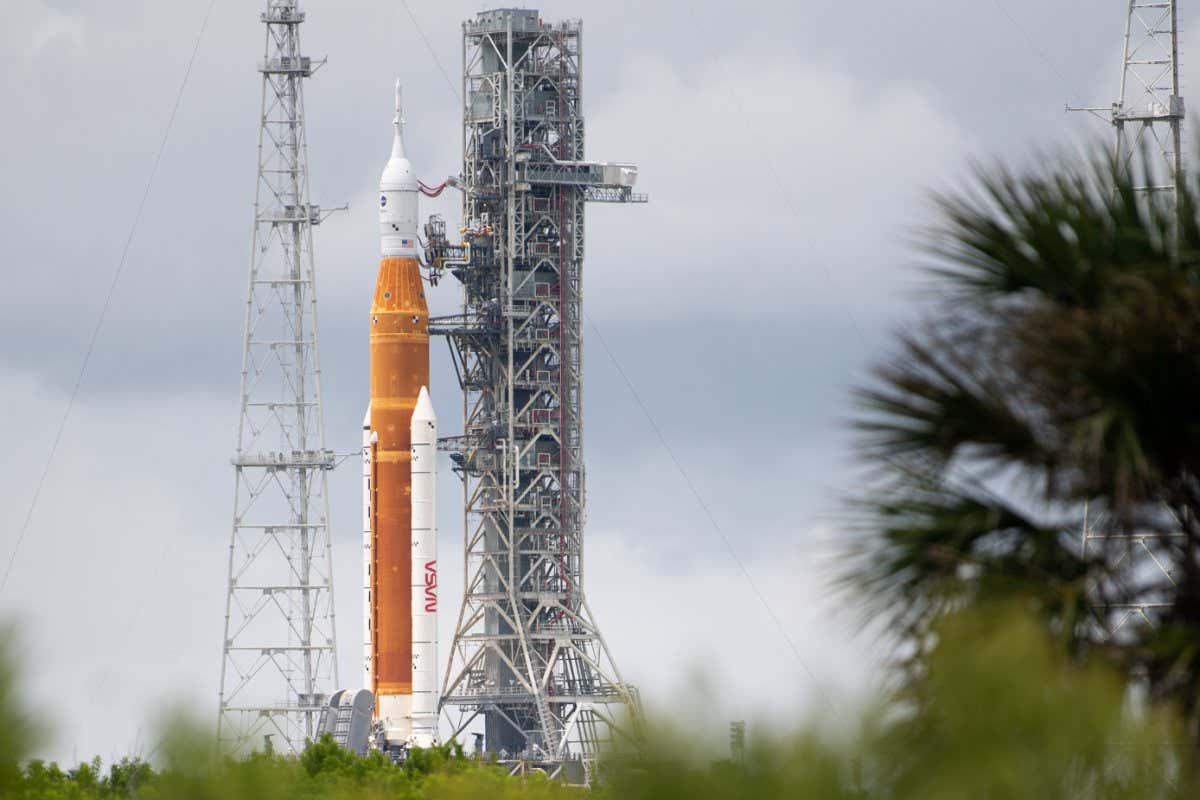
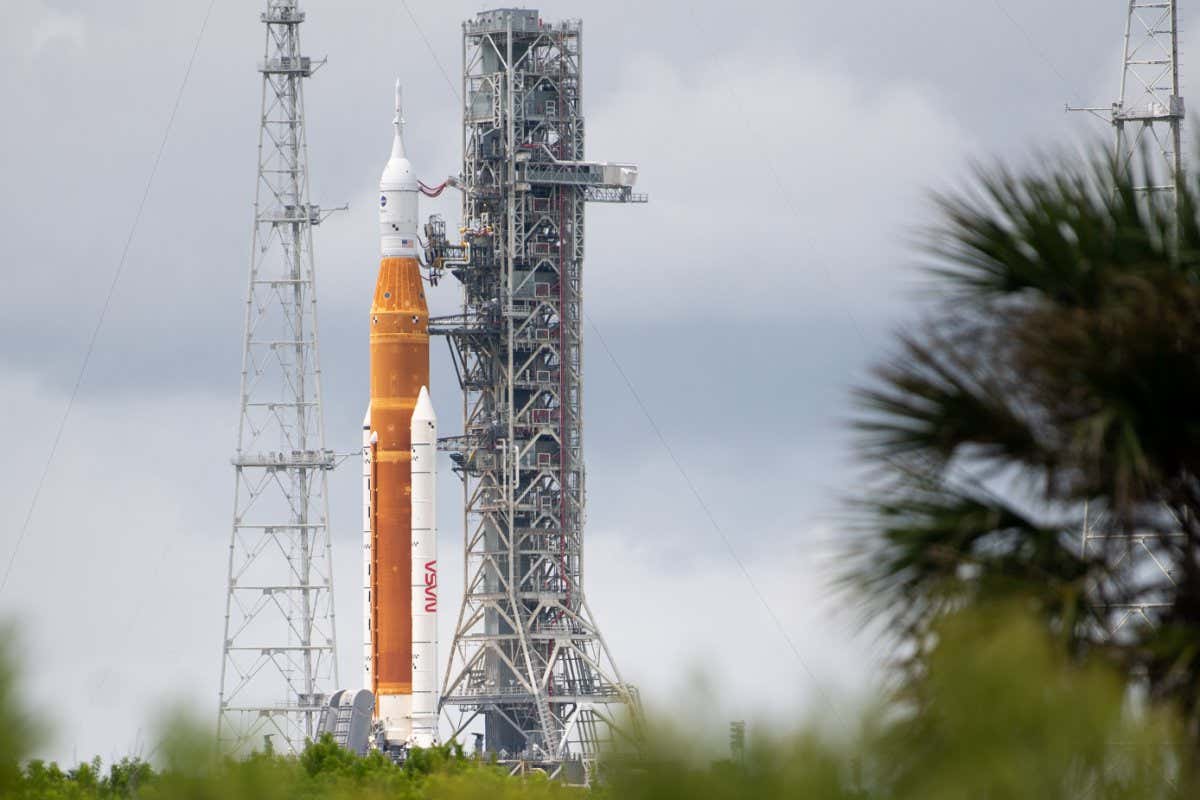
NASA’s Space Launch System rocket with the Orion spacecraft on top at Kennedy Space Center in Florida
NASA/Joel Kowsky
The Artemis I mission marks the beginning of a new era of human exploration for NASA. While the first launch of the Space Launch System (SLS) rocket won’t be crewed, Artemis II will take astronauts around the moon. The third Artemis flight will take humans back to the lunar surface for the first time since the Apollo 17 mission in 1972. NASA associate director Thomas Zurbuchen has been key to the programme’s development. New Scientist reporter Leah Crane caught up with him in Cape Canaveral, Florida, shortly before Artemis I’s first launch attempt on 29 August, which had to be delayed due to technical difficulties. The new launch date is planned for 3 September.
How are you feeling? Excited? Nervous?
Whenever you do a thing like this where everything has to work, there is of course excitement, elation, pride for the team – but there’s some worry too, because you’ve bet it all on this one moment. There’s fear, even, that something might go wrong because a lot has to go right.
Advertisement
Aside from the launch itself, is there anything we are going to learn that you are particularly excited for?
There are a number of science investigations that are on there, much of it related to radiation, both with CubeSats [miniature satellites] and also radiation experiments on Orion. I’m really excited about learning about the deep-space environment in the context of humans. We haven’t really thought about that for 50 years with that intensity.
It has been a long road to this point, with countless delays and budget overruns. Was it all worth it?
It has to be. And it will be. After 20 years in low Earth orbit, we need to go beyond. Getting to that, I wish it was easier, but the journey starts with this.
How far ahead has NASA planned after this first SLS launch?
We have to be really suspect of plans. The first three Artemis missions we really need to make happen. We need to get back to the surface of the moon, and there’s no shortcut. We need to be working on all three of those missions now.
When you go to Artemis IV through VII, of course we’re working on those, but on a timescale of 10 years, let’s say, or 15 years, there are a lot of variables that will adjust. The question is, how many large launchers will we have? There’s one large launcher sitting on the pad – are there going to be others? How many in the private sector? How many internationally?
The next question is, what will we discover relative to science of the moon doing these first missions? What we discover is very much driving the future plan. The plans beyond the next few Artemis missions really should be adaptable, they need to be.
After this first uncrewed SLS launch, how much harder is it to put people in the Orion crew capsule on the rocket?
It’s a lot harder. There are a lot of problems. First of all, this is the first journey, and I actually believe that the risk for Orion is higher than the risk for the rocket. Bringing Orion back is going to be as big a challenge as getting off Earth.
Why is that?
Frankly, I sat through 11-plus hours of system reviews so I looked at every one of the risks that are there. The heat shield is the prime one that people have talked about, but the whole integration of the system of the European Service Module with the other pieces, the propulsion piece, the orbit injection, how is it all going to work – it’s just not easy. The whole [communications] piece with this complex orbit, the orbital debris piece, the risks just add up. The mission is only over once Orion is down safely here.
Are we using a lot of knowledge that we gained from the Apollo programme?
Yes, we should always learn everything we can learn from the previous generation, but I think this is also entirely new – we’re going back to a different moon than we left. The questions that we have are very different, and the tools of investigation – small satellites were not a thing, AI was not a thing, massive amounts of data that we can analyse were not a thing. I think there’s going to be exciting science coming from it, without a doubt.
The purpose of the Artemis missions is very different from the Apollo programme – we aren’t just going to plant a flag. How has that affected the mission plan?
When you go for the first time back with humans to the surface of the moon, the most important objective is to make humans survive, whether or not you have a science purpose. As we move forward, when we go beyond the Artemis III mission, the science becomes much more dominant. We’re already talking right now about what kinds of handheld instruments we give the astronauts, how much sample mass can we bring back? Because we think the samples are just as important as anything that’s happening on the surface of the moon. The role that science has is increasing as we go.
Sign up to our free Launchpad newsletter for a voyage across the galaxy and beyond, every Friday