




A pair of rocky planets orbiting the star LP 890-9, also known as SPECULOOS 2, seem likely to be in the habitable zone and one of them could be the second most habitable exoplanet discovered so far
Space 7 September 2025
By Alex Wilkins
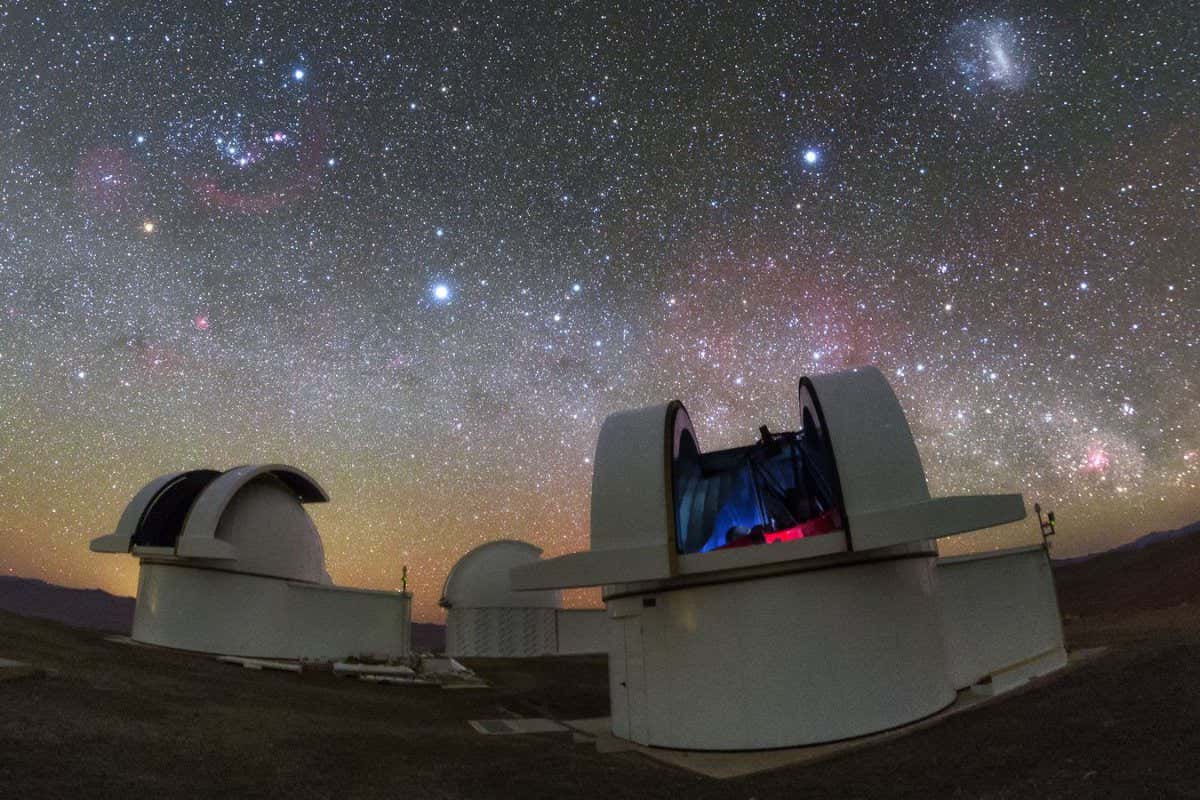
The telescopes of the SPECULOOS Southern Observatory in the Atacama desert in Chile were used to discover SPECULOOS-2c
ESO/P. Horálek
A pair of rocky planets slightly larger than Earth are orbiting in the habitable zone around a dim red dwarf star and one may be the second most Earth-like exoplanet discovered so far.
The planets are called LP 890-9b – which had been spotted before but we knew little about it – and LP 890-9c, also called SPECULOOS-2c.
Only a few details are known about SPECULOOS-2c beyond its size and the eight days it takes to orbit its star, LP 890-9, also known as SPECULOOS 2. Amaury Triaud at the University of Birmingham, UK, and his colleagues, who spotted it, hope the James Webb Space Telescope (JWST) might tell us more about whether it has an atmosphere and what it contains.
Advertisement
This could inform us about the planet’s potential to host life. Being in the habitable zone around a star means the conditions aren’t too hot or too cold, so liquid water could exist on the surface.
To find planets in other solar systems, astronomers can look for a star’s light dimming as a planet passes in front of it, disturbing our view. This is hard to do when a star is as bright as our own sun because the planets are comparatively dim, but easier if the host star is cooler and darker, like red dwarfs.
SPECULOOS 2c has a radius 30 to 40 per cent larger than Earth’s and takes just 8.4 days to orbit its star. It is also tidally locked, which means it has a permanent day on one side and it is always night on the other. Despite these differences, the team estimates that it appears to be the second most habitable planet discovered so far, after TRAPPIST-1e, outside our solar system, and could still potentially have liquid water on its surface.
Triaud and his colleagues announced the discovery of TRAPPIST-1e in 2016 in a haul of at least three potentially habitable Earth-sized planets orbiting a red dwarf star called TRAPPIST-1. In the following years, four more TRAPPIST planets were identified and the information gleaned suggested that at least three of them were in the habitable zone. TRAPPIST 1e, appeared to be the most likely to be an Earth-like ocean world.
SPECULOOS-2c doesn’t seem far off it, according to the data the team measured.
“The outer planet is in the inner edge of what is called the habitable zone, a bit like the Earth is,” says Triaud. “From my calculation, the system is the second best at the moment to study the climate of or find out the atmosphere with an instrument like the JWST.”
In 2021, NASA’s Transiting Exoplanet Survey Satellite (TESS), which scans the entire sky for exoplanets, released a list of newly discovered potential planets. One of these, TOI-4306.01, also called LP 890-9b, caught the attention of Triaud and his team, so they followed-up with ground-based telescopes around the world, for more than 600 hours of observation on its host star.
As well as confirming TESS’s initial finding, they also discovered a second planet, SPECULOOS-2c. They couldn’t measure any other details apart from its radius and orbit but based on how closely it orbits its star and its estimated radiation, and a projected mass from its radius based on what we know about other exoplanets, Triaud and his team calculated it was squarely in the habitable zone.
The definition of a habitable zone for a particular star changes depending on that star’s properties, but the researchers hope that observations with JWST might help them tweak their definition and reveal much more, such as the planets’ masses and whether they have atmospheres
The discovery of these planets, especially the inner one, and further observations with JWST could help us understand what makes a planet habitable, says Beth Biller at the University of Edinburgh, UK. However, the planet’s larger-than-Earth size and closer proximity to its host star, which might imply a higher level of powerful radiation, counts against its potential habitability, she says.
Journal reference: Astronomy & Astrophysics, DOI: 10.1051/0004-6361/202244041
Sign up to our free Launchpad newsletter for a voyage across the galaxy and beyond, every Friday
More on these topics: