



A sustained, stable experiment is the latest demonstration that nuclear fusion is moving from being a physics problem to an engineering one
Physics 7 September 2025
By Matthew Sparkes
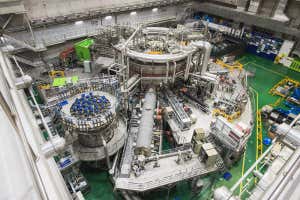
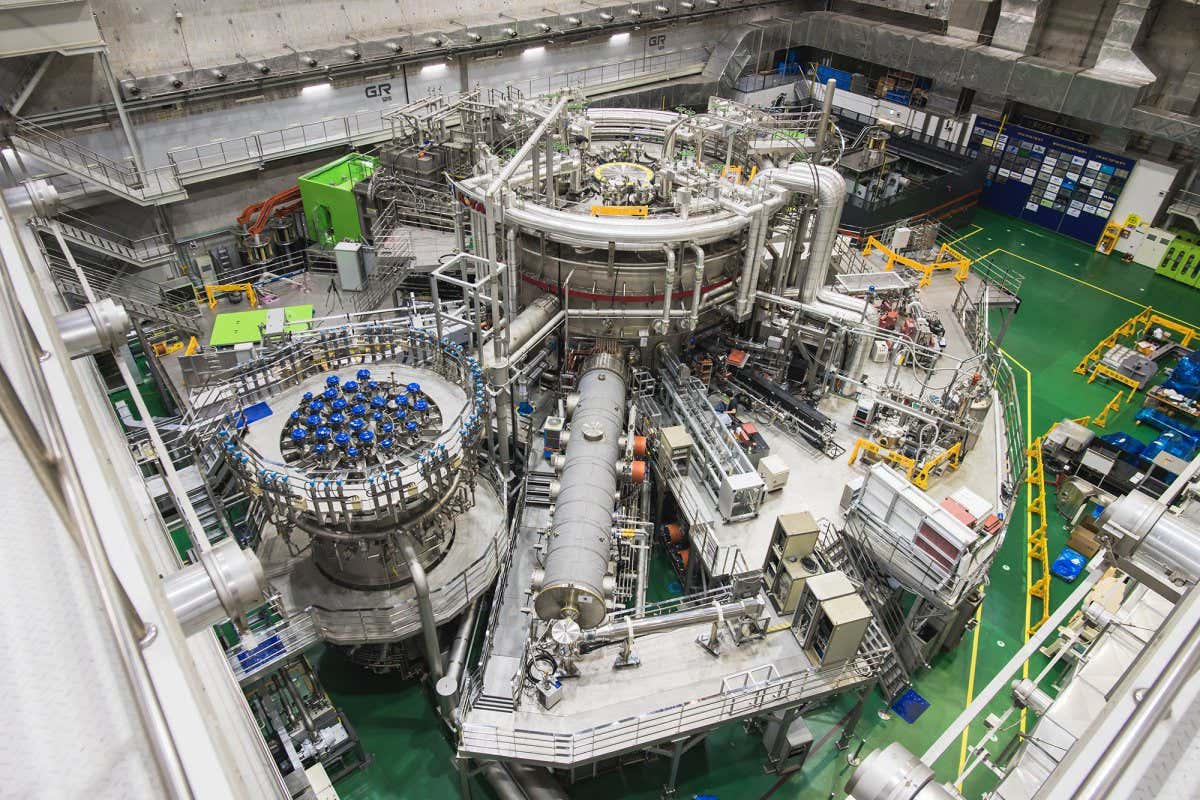
The Korea Superconducting Tokamak Advanced Research experiment
Korea Institute of Fusion Energy
A nuclear fusion reaction has lasted for 30 seconds at temperatures in excess of 100 million°C. While the duration and temperature alone aren’t records, the simultaneous achievement of heat and stability brings us a step closer to a viable fusion reactor – as long as the technique used can be scaled up.
Most scientists agree that viable fusion power is still decades away, but the incremental advances in understanding and results keep coming. An experiment conducted in 2021 created a reaction energetic enough to be self-sustaining, conceptual designs for a commercial reactor are being drawn up, while work continues on the large ITER experimental fusion reactor in France.
Now Yong-Su Na at Seoul National University in South Korea and his colleagues have succeeded in running a reaction at the extremely high temperatures that will be required for a viable reactor, and keeping the hot, ionised state of matter that is created within the device stable for 30 seconds.
Advertisement
Controlling this so-called plasma is vital. If it touches the walls of the reactor, it rapidly cools, stifling the reaction and causing significant damage to the chamber that holds it. Researchers normally use various shapes of magnetic fields to contain the plasma – some use an edge transport barrier (ETB), which sculpts plasma with a sharp cut-off in pressure near to the reactor wall, a state that stops heat and plasma escaping. Others use an internal transport barrier (ITB) that creates higher pressure nearer the centre of the plasma. But both can create instability.
Na’s team used a modified ITB technique at the Korea Superconducting Tokamak Advanced Research (KSTAR) device, achieving a much lower plasma density. Their approach seems to boost temperatures at the core of the plasma and lower them at the edge, which will probably extend the lifespan of reactor components.
Dominic Power at Imperial College London says that to increase the energy produced by a reactor, you can make plasma really hot, make it really dense or increase confinement time.
“This team is finding that the density confinement is actually a bit lower than traditional operating modes, which is not necessarily a bad thing, because it’s compensated for by higher temperatures in the core,” he says. “It’s definitely exciting, but there’s a big uncertainty about how well our understanding of the physics scales to larger devices. So something like ITER is going to be much bigger than KSTAR”.
Na says that low density was key, and that “fast” or more energetic ions at the core of the plasma – so-called fast-ion-regulated enhancement (FIRE) – are integral to stability. But the team doesn’t yet fully understand the mechanisms involved.
The reaction was stopped after 30 seconds only because of limitations with hardware, and longer periods should be possible in future. KSTAR has now shut down for upgrades, with carbon components on the wall of the reactor being replaced with tungsten, which Na says will improve the reproducibility of experiments.
Lee Margetts at the University of Manchester, UK, says that the physics of fusion reactors is becoming well understood, but that there are technical hurdles to overcome before a working power plant can be built. Part of that will be developing methods to withdraw heat from the reactor and use it to generate electrical current.
“It’s not physics, it’s engineering,” he says. “If you just think about this from the point of view of a gas-fired or a coal-fired power station, if you didn’t have anything to take the heat away, then the people operating it would say ‘we have to switch it off because it gets too hot and it will melt the power station’, and that’s exactly the situation here.”
Brian Appelbe at Imperial College London agrees that the scientific challenges left in fusion research should be achievable, and that FIRE is a step forwards, but that commercialisation will be difficult.
“The magnetic confinement fusion approach has got a pretty long history of evolving to solve the next problem that it comes up against,” he says. “But the thing that makes me kind of nervous, or uncertain, is the engineering challenges of actually building an economical power plant based on this.”
Journal reference: Nature, DOI: 10.1038/s41586-022-05008-1
More on these topics: