



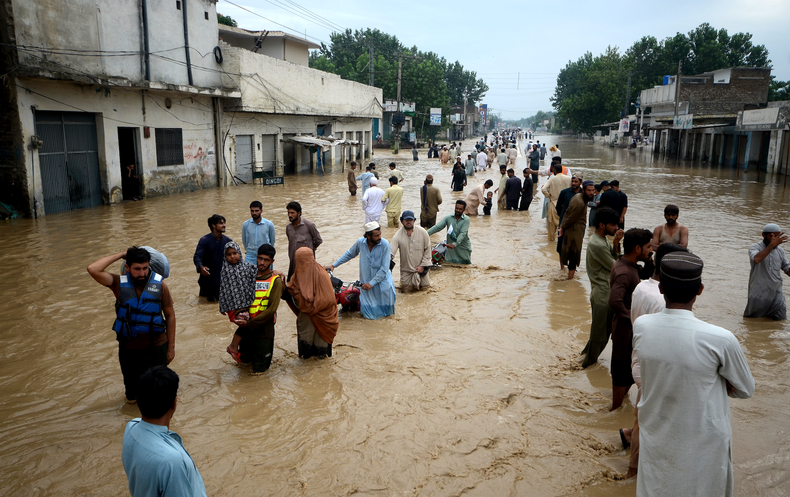

With rivers breaking their banks, flash flooding and glacial lakes bursting, Pakistan is experiencing its worst floods this century. At least one-third of the country is under water. Scientists say several factors have contributed to the extreme event, which has displaced some 33 million people and killed more than 1,200.
Researchers say the catastrophe probably started with phenomenal heatwaves. In April and May, temperatures reached above 40 °C for prolonged periods in many places. On one sweltering day in May, the city of Jacobabad topped 51 °C. “These were not normal heatwaves — they were the worst in the world. We had the hottest place on Earth in Pakistan,” says Malik Amin Aslam, the country’s former minister for climate change, who is based in Islamabad.
Warmer air can hold more moisture. So meteorologists warned earlier this year that the extreme temperatures would probably result in “above normal” levels of rain during the country’s monsoon season, from July to September, says Zia Hashmi, a water-resources engineer at the Global Change Impact Studies Centre in Islamabad, speaking in his personal capacity.
Glacial melt
The intense heat also melted glaciers in the northern mountainous regions, increasing the amount of water flowing into tributaries that eventually make their way into the Indus river, says Athar Hussain, a climate scientist at COMSATS University Islamabad. The Indus is Pakistan’s largest river, and runs the length of the country from north to south, feeding towns, cities and large swathes of agricultural land along the way. It isn’t clear exactly how much excess glacial melt has flowed into rivers this year, but Hashmi visited some high-altitude glaciated regions in July and noticed high flows and muddy water in the Hunza River, which feeds into the Indus. He says the mud suggests that there has been rapid melting, because fast water picks up sediment as it moves downstream. Several glacial lakes have burst through the dams of ice that normally restrain them, releasing a dangerous rush of water.
The heatwaves also coincided with another extraordinary event — a depression, or a system of intense low air pressure, in the Arabian Sea, which brought heavy rain to Pakistan’s coastal provinces as early as June. “We rarely have large-scale depression systems arriving there,” says Hussain.
These unusual features were then exacerbated by the early arrival of the monsoon on 30 June, which “was wetter generally over a larger region for a very prolonged period of time”, says Andrew King, a climate scientist at the University of Melbourne, Australia.
The effect is that Pakistan has received almost three times its average annual rainfall for the monsoon period so far. The southern provinces of Sindh and Baluchistan have received more than five times that average. “The flooding is all over,” says Hashmi.
Once on land, much of that water has nowhere to go. More than 1.2 million houses, 5,000 kilometres of road and 240 bridges have been destroyed. In Sindh, an elongated lake has formed, tens of kilometres wide, and more water will continue to pour into it, says Aslam. “The worst is not over.”
Other factors
Some weather agencies have also predicted that the ongoing La Niña climate event — a phenomenon that is typically associated with stronger monsoon conditions in India and Pakistan — will continue until the end of the year, says King. “It’s not a super strong link, but it probably is playing a role in enhancing the rainfall.”
Human-induced global warming could also be intensifying downpours. Climate models suggest that a warmer world will contribute to more intense rainfall, says Hussain. Between 1986 and 2015, temperatures in Pakistan rose by 0.3 °C per decade — higher than the global average.
Researchers and public officials also say that other factors have probably added to the devastation, including an ineffective early-warning system for floods, poor disaster management, political instability and unregulated urban development. A lack of drainage and storage infrastructure, as well as the large number of people living in flood zones, are also implicated. “These are governance issues, but they are minuscule in relation to the level of the tragedy that we are seeing occur,” says Aslam.
This article is reproduced with permission and was first published on September 2 2022.