


By using this site, you agree to the Privacy Policy and Terms of Use.
Accept
Forbes ukForbes uk
Notification Show More
Latest News
JWST’s dazzling nebula image shows stars we have never seen
Science
These are all the reasons you need to make lube
Health
Red-eyed tree frogs prefer mates whose croak vibrations they can
Science
Does monkeypox lead to heart problems? Know what experts say
Health
Weird, enormous planets may be stolen from stars in ‘planetary
Science
Aa
  • U.K News
  • Business
  • Money
  • Health
  • Entertainment
  • Science
  • Technology
  • Insider
Reading: JWST’s dazzling nebula image shows stars we have never seen
Share
Aa
Forbes ukForbes uk
Search
  • U.K News
  • Business
  • Money
  • Health
  • Entertainment
  • Science
  • Technology
  • Insider
Have an existing account? Sign In
Follow US
Forbes uk > Blog > Science > JWST’s dazzling nebula image shows stars we have never seen
Science

JWST’s dazzling nebula image shows stars we have never seen

Jake
Last updated: 2025/09/13 at 4:56 PM
Jake Published September 13, 2025
Share
SHARE

Astronomers have used the James Webb Space Telescope to peer through the filaments of dust and gas in the Tarantula Nebula, the brightest and biggest stellar nursery around

Space 6 September 2025

By Leah Crane
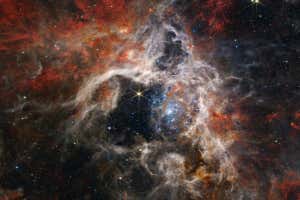
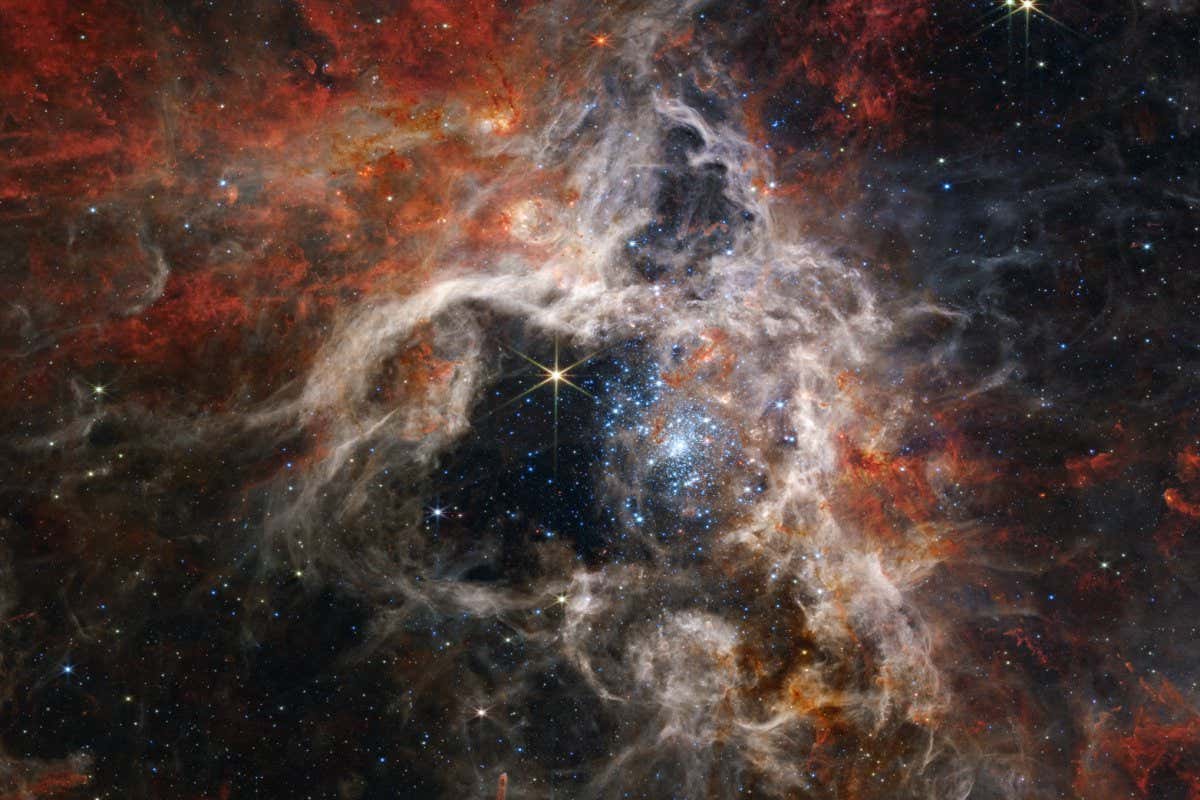
In this mosaic image stretching 340 light-years across, Webb?s Near-Infrared Camera (NIRCam) displays the Tarantula Nebula star-forming region in a new light, including tens of thousands of never-before-seen young stars that were previously shrouded in cosmic dust. The most active region appears to sparkle with massive young stars, appearing pale blue. Scattered among them are still-embedded stars, appearing red, yet to emerge from the dusty cocoon of the nebula. NIRCam is able to detect these dust-enshrouded stars thanks to its unprecedented resolution at near-infrared wavelengths.

The Tarantula Nebula as seen by JWST’s Near-Infrared Camera

NASA, ESA, CSA, STScI

Amid an enormous cloud of dust and gas, thousands of stars are forming. Many of these stars have never been seen before, but these images from the James Webb Space Telescope (JWST) are revealing them for the first time.

These pictures show the Tarantula Nebula, located about 161,000 light-years away in the Large Magellanic Cloud – a galaxy that orbits the Milky Way. The nebula is the biggest and brightest one in all the nearby galaxies, and hosts some of the hottest and most massive stars astronomers have ever seen.

The massive young stars that form a sparkling blue cluster near the centre of the above image have cleared out the gas around them with their powerful radiation and intense stellar winds, revealing pillars of relatively dense gas inside which more young stars are forming. The above image was taken with JWST’s Near-Infrared Camera (NIRCam), showing the dusty filaments that make up the web of the Tarantula Nebula.

Advertisement

But viewed in longer wavelengths by JWST’s Mid-infrared Instrument (MIRI) in the picture below, the web takes on a different countenance. These wavelengths allow us to peer deeper into the cloud than ever before, and tiny points of light indicate protostars still in the process of formation. Hydrocarbons, shown in blue and purple, skim the edges of dust clouds like ghostly veils, while the densest areas of dust obstruct JWST’s view completely, as in the lower left corner.
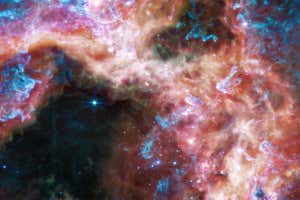
At the longer wavelengths of light captured by its Mid-Infrared Instrument (MIRI), Webb focuses on the area surrounding the central star cluster and unveils a very different view of the Tarantula Nebula. In this light, the young hot stars of the cluster fade in brilliance, and glowing gas and dust come forward. Abundant hydrocarbons light up the surfaces of the dust clouds, shown in blue and purple. Much of the nebula takes on a more ghostly, diffuse appearance because mid-infrared light is able to show more of what is happening deeper inside the clouds. Still-embedded protostars pop into view within their dusty cocoons, including a bright group at the very top edge of the image, left of center. Other areas appear dark, like in the lower-right corner of the image. This indicates the densest areas of dust in the nebula, that even mid-infrared wavelengths cannot penetrate. These could be the sites of future, or current, star formation.

NASA, ESA, CSA, STScI, Webb ERO Production

The Tarantula Nebula is of particular interest to astronomers because of its frenzied rate of star formation – nowhere in our own galaxy are stars formed in such huge quantities. This makes it relatively similar to dusty galaxies from billions of years ago, when star formation in the universe was at its most intense in the universe’s so-called cosmic noon. JWST will be able to observe those galaxies, so comparing those observations with the more detailed ones of this nebula may help us understand the universe’s most active time.

Sign up to our free Launchpad newsletter for a voyage across the galaxy and beyond, every Friday

More on these topics:

You Might Also Like

Red-eyed tree frogs prefer mates whose croak vibrations they can

Weird, enormous planets may be stolen from stars in ‘planetary

Jacob Rees-Mogg: Climate change concern over new energy policy chief

Swarm of light-sail spacecraft could be propelled by laser on

TAGGED: art, galaxy, Science, universe
Jake September 13, 2025
Share this Article
Facebook Twitter Email Print
Leave a comment

Click here to cancel reply.

Please Login to Comment.

Follow US

Find US on Social Medias
Facebook Like
Twitter Follow
Youtube Subscribe
Telegram Follow

Weekly Newsletter

Subscribe to our newsletter to get our newest articles instantly!

Popular News
Business

Starbucks to unveil ‘reinvention’ strategy at investor day on Tuesday

Jake Jake September 13, 2025
Fasted cardio vs fed state cardio: What’s better for faster
Physicists Struggle to Unite around Future Plans
The Silent Sea review: South Korean series is a slice
5 tips to ward off exam stress and anxiety in
- Advertisement -
Ad imageAd image
Global Coronavirus Cases

Confirmed

609.12M

Death

6.52M

More Information:Covid-19 Statistics

Categories

  • ES Money
  • U.K News
  • The Escapist
  • Insider
  • Science
  • Technology
  • LifeStyle
  • Marketing

About US

We influence 20 million users and is the number one business and technology news network on the planet. For Post an Article Email! post@forbese.co.uk
Quick Link
  • My Bookmark
  • Interests
  • Contact Us
  • Blog Index
Top Categories
  • U.K News
  • Business
  • Money
  • Health
  • Entertainment
  • Science
  • Technology
  • Insider

Subscribe US

Subscribe to our newsletter to get our newest articles instantly!

© FORBESE.CO.UK. All Rights Reserved.

Removed from reading list

Undo
Welcome Back!

Sign in to your account

Lost your password?