




For the first time, astronomers using the James Webb Space Telescope have directly captured an image of an exoplanet from space
Space 1 September 2025
By Alex Wilkins
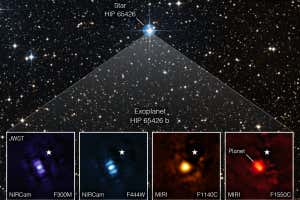
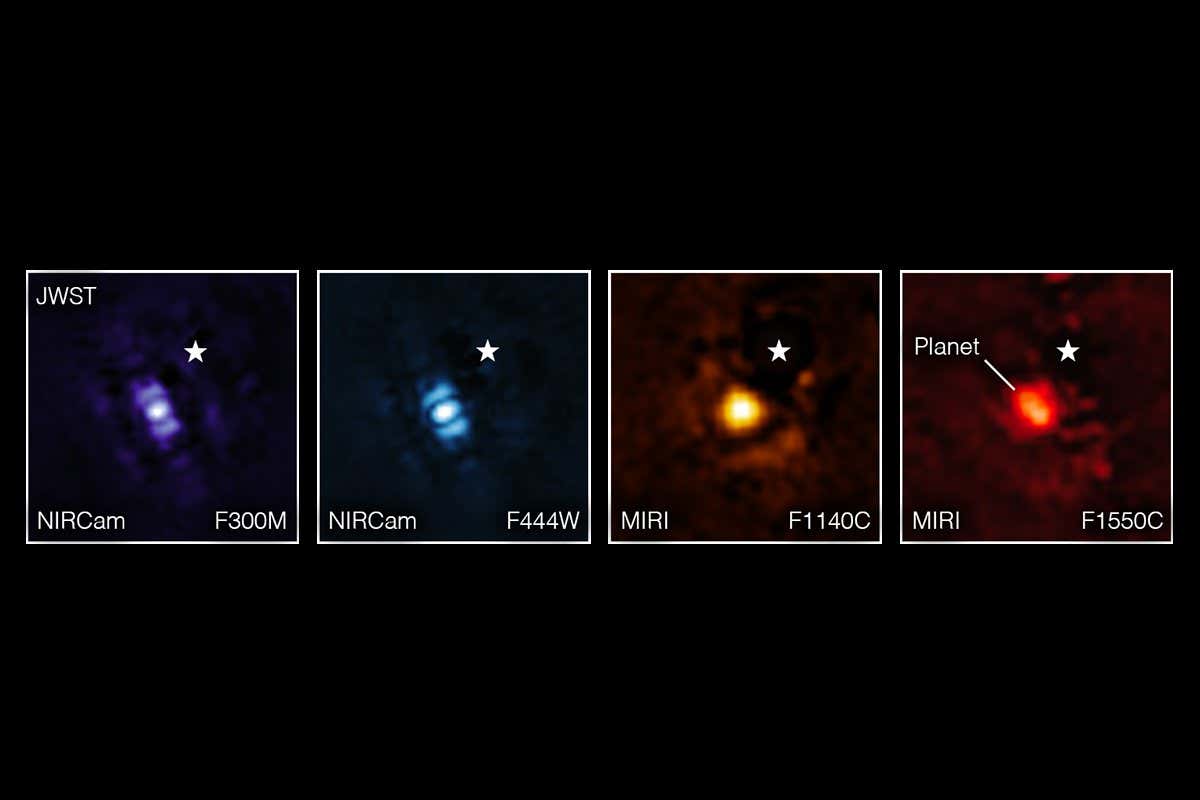
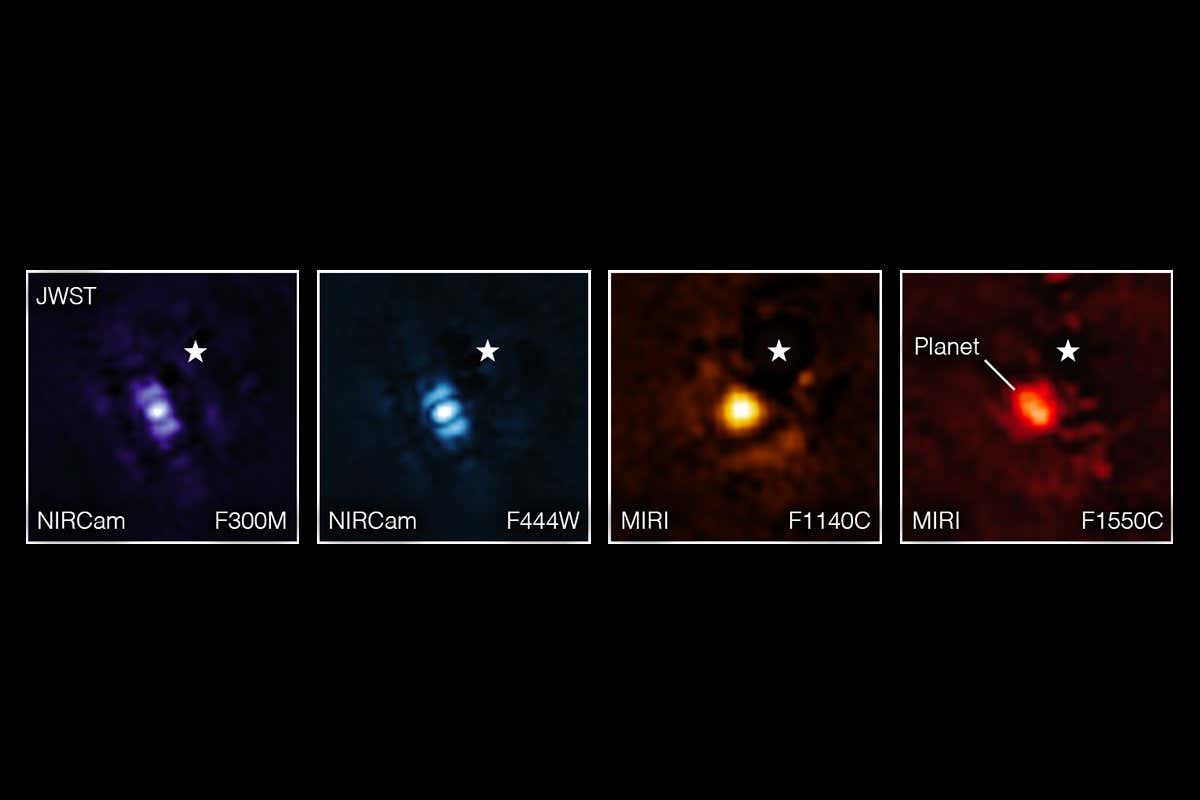
The exoplanet HIP 65426 b as seen by the NIRCam and MIRI instruments on the James Webb Space Telescope
NASA/ESA/CSA, A Carter (UCSC), ERS 1386 team, A. Pagan (STScI)
The James Webb Space Telescope (JWST) has captured its first images of an alien world – and because the telescope is performing 10 times better than expected, we are likely to see many more in future.
Astronomers have taken direct images of just 20 exoplanets, all from Earth-based telescopes. But because our planet’s atmosphere blocks out a large parts of the infrared range, it has been difficult to detect features of these planets in any great detail.
“Being here on Earth really sets a sensitivity floor to what we’re able to detect, and to this day, the lowest mass planet we’ve been able to detect is about two Jupiter masses,” says Sasha Hinkley at the University of Exeter, UK.
Advertisement
Now, Hinkley and his colleagues have used JWST to directly image a so-called super-Jupiter exoplanet, HIP 65426 b, which is around seven Jupiter masses and orbits a star around 400 light years from Earth. The team captured it in a range of infrared wavelengths and at a precision that had previously been impossible.
“What we know from these observations is that JWST is going to shatter that sensitivity floor,” says Hinkley. Future observations should be able to go far below the mass of Jupiter, he says. “It’s going to allow us to get down to planets that are analogues of ice giants in our own solar system. These might be things like Saturns, or possibly even Neptunes if we’re lucky.”
HIP 65426 b is relatively young and hot, meaning it is easier to image. It had previously been observed by ground-based telescopes, which is why the researchers used it to test out JWST’s exoplanet-imaging capabilities. They found that JWST performed 10 times better than expected and was much more sensitive than any previous telescopes.
“We get just exquisite sensitivity with JWST, so we can see really faint objects, especially if they’re a bit further from the star,” says team member Beth Biller at the University of Edinburgh, UK.
It was also especially precise when measuring changes in brightness for the exoplanet. “Variability of brightness really means something like clouds, it means weather, on these exoplanets, so this probably means that JWST is going to be sensitive enough to search for things like clouds,” says Hinkley.
The team captured the planet in a range of different infrared wavelengths, from the near-infrared that had been used in previous images to mid-infrared wavelengths that had never been used before. “By observing these planets over such a wide range of wavelengths, we just have more information,” says Hinkley. “We have more information about the chemical compositions of their atmospheres and their chemical enrichment. This is really important because understanding what these planets are made of and their chemical constituents might tell us something about their formation process.”
Imaging HIP 65426 b is tricky because it orbits so close to its host star, which creates a high contrast in brightness. Hinkley and his team used a coronagraph to block out the star’s light, allowing them to see the image across a range of wavelengths. The planet looks a little different depending on which of JWST’s two infrared instruments, NIRCam and MIRI, were used, because of the way these devices process the images, says Biller – you can see some of these different images in the picture above.
Because JWST is in such demand to observe many different astronomical objects, it isn’t actually the optimal exoplanet-imaging device, says Michael Merrifield at the University of Nottingham, UK. “But it’s such a big leap forward on everything that actually I think it will probably take us into regimes we’ve never been to before.”
That said, there are limits. Exoplanets are so far away from Earth and such difficult objects to image that JWST can’t capture high-resolution pictures that look like planets in our own solar system. However, Hinkley hopes that lessons learned from JWST will eventually lead to a telescope that can glimpse an Earth-sized planet around another star.
“Ultimately, we want to get that image of an exo-Earth someday and these observations are really the beginning of learning how to do coronagraphy in space,” he says.
Reference: arxiv.org/abs/2208.14990
Sign up to our free Launchpad newsletter for a voyage across the galaxy and beyond, every Friday
More on these topics: