




Located an hour’s drive from the city of Dunedin on New Zealand’s South Island, Foulden Maar has become one of the world’s most significant but troubled fossil sites. This shallow-sided volcanic crater lake (called a maar) was formed in a violent explosion 23 million years ago—the start of the Miocene epoch, when the climate in this part of the world was much warmer and wetter than it is now.
For at least 120,000 years, a rain forest grew around the lake. In its waters, tiny single-celled algae called diatoms bloomed each spring and summer and then died and sank to the bottom. “The diatoms are the most important fossils in a way, because without them, we wouldn’t have the other things preserved,” says Daphne Lee, a geologist at the University of Otago in New Zealand, who has led scientific excavations at Foulden Maar for nearly two decades.
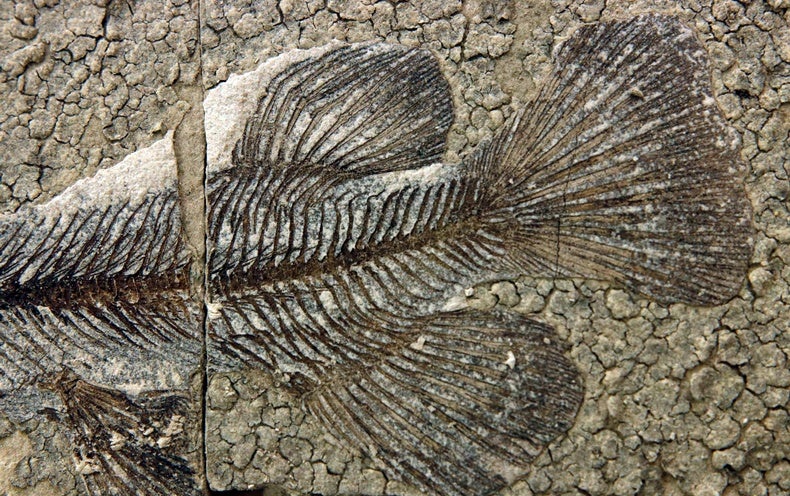
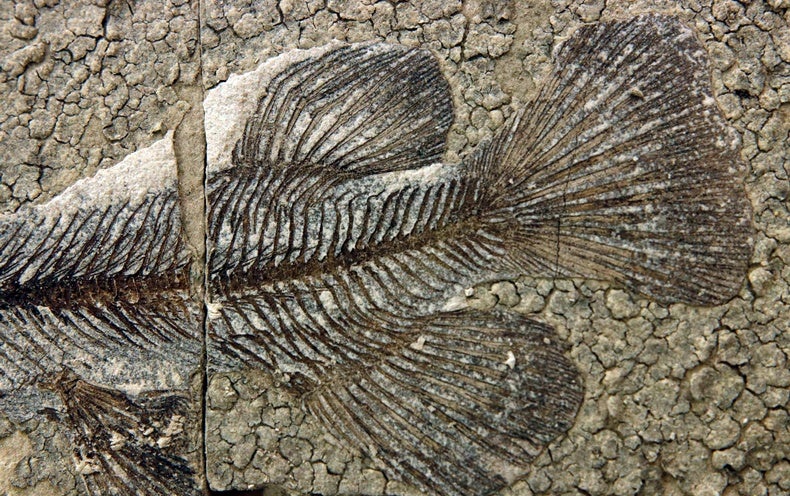
And those other fossil plants and animals are sensational. Lee and her colleagues unearthed an entire ecosystem, perfectly captured in the powdery diatomite rock: spiders, dragonflies, fruits, flowers complete with pollen grains resting on their petals, fish with scalloped scales, intricate termite wings, the hexagonal lattice of a fly’s compound eyes, and iridescent beetles still glistening in green, copper and bronze.
Most frequently of all, they found leaves—so delicately pressed that climate scientists could analyze their structure and chemical composition to discover that atmospheric carbon dioxide in the early Miocene reached 550 parts per million, levels similar to those predicted for Earth by 2050.
Lee and her colleagues published scientific papers on their findings, but they didn’t talk more widely about the site. “Because we’d been trying to keep on good terms with mining companies [that owned the land], of whom there were several, we didn’t give the site the public recognition it deserved,” she says.
But in 2019, when a leaked document revealed the latest company to own the mine, Plaman Resources, planned to dig up the entire site and export the diatomite as an animal food supplement, Lee was galvanized into activism. She began speaking to the media, local authorities and the public at meetings about Foulden Maar. Along with paleontologist Uwe Kaulfuss and palaeobotanist John Conran, she started work on a book. Fossil Treasures of Foulden Maar: A Window into Miocene Zealandia, published in New Zealand this week by Otago University Press and available in the U.S. this December, is an illustrated guide to the site’s history, science and fossil discoveries. “I thought, ‘Well, if we’ve got to the point where this whole site might be destroyed, we really must get this story out there,’” Lee says.
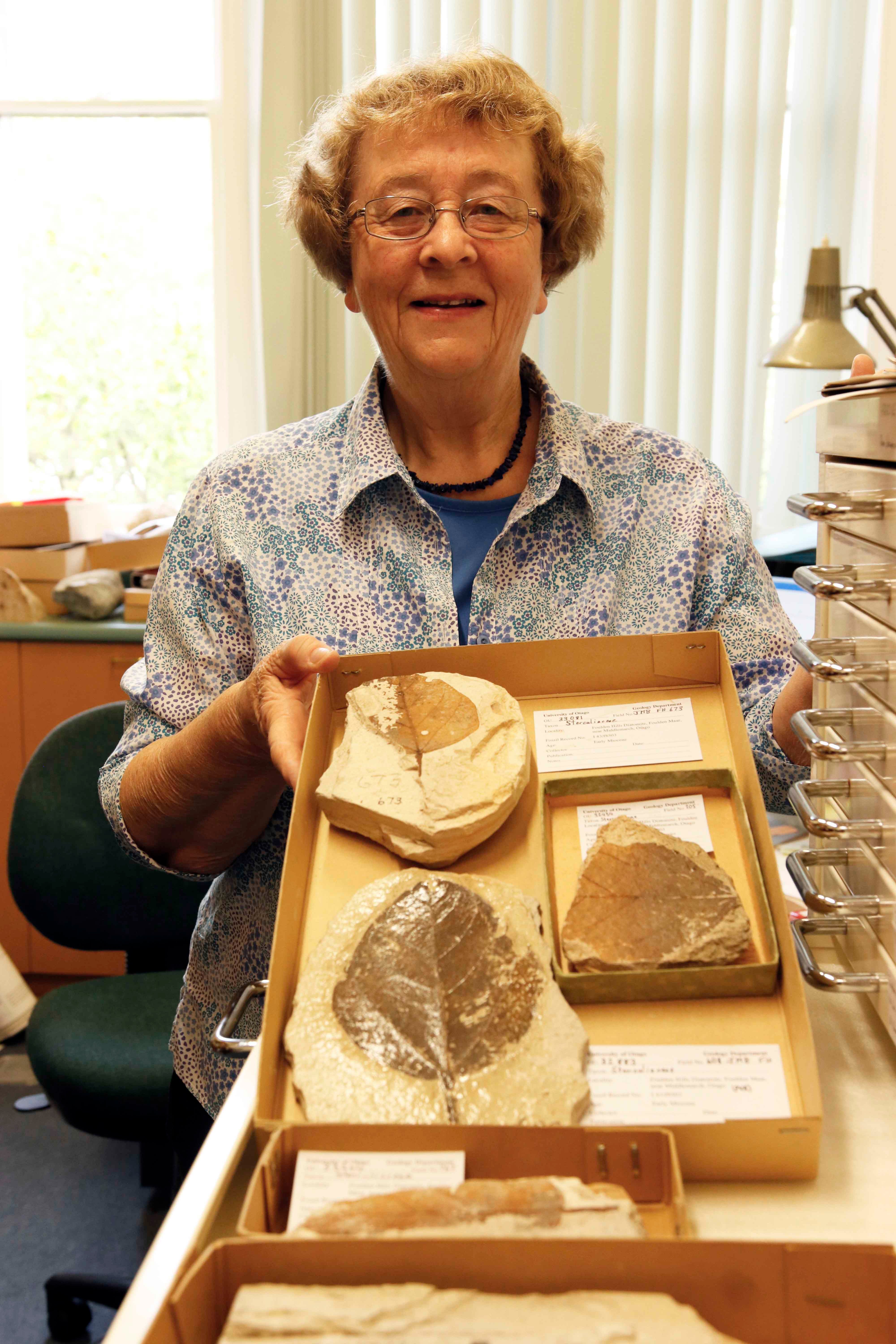 University of Otago geologist Daphne Lee. Credit: Kate Evans
Though public pressure played a role in Plaman Resources abandoning its mining plans, and the company became insolvent later in 2019, Foulden Maar still has no formal protection. For three years, the Dunedin City Council—which says it hopes to buy the site and save it for science—has been locked in negotiations with the company appointed to manage Plaman’s business affairs, called its receiver. Neither party would comment to the Scientific American on the progress of those discussions. And in the limbo, scientists are barred from visiting the site.
Scientific American spoke with Lee about the fossil treasures of Foulden Maar, what they reveal about our planet’s past and her hopes for the site’s future.
[An edited transcript of the interview follows.]
The book tells the story of this place. Why is it so important?
First, it has the most amazing preservation of fossils. It’s one of a few sites in the world that have Lagerstätte preservation. That’s a word used for real fossil treasure troves, where you have even the soft parts of fossils—things like eyes and skin and flowers with petals and pollen, things that are almost never preserved in any other situation. Foulden gives a snapshot of biodiversity that is just not available anywhere else on the planet.
The other thing about Foulden is that we’ve got two ecosystems preserved. It was a very small lake, maybe a couple of hundreds of meters deep and a kilometer across. But because of the way the diatomite sediment built up on the floor, everything that lived in the lake and fell to the bottom is pickled [preserved in liquid] there.
And not just that—the rain forest ecosystem around the lake is also preserved: every leaf, every flower that was blown in, every insect. It’s at such high resolution that we’ve got this year-by-year record. It’s because it was a closed system and was small and deep that you get this kind of preservation.
It’s very, very unusual to have this combination of factors all coming together at this one site, and it means we can build up a really detailed and accurate picture—just about go back in time and take a walk through the forest and dive into the lake.
Tell me about some of the spectacular fossils that have been found at the site over the years. There have been orchids, bird poop, dragonflies, ants. What else was discovered?
There were fish swimming around in the lake, and there must have been lots of eels. My colleague Uwe Kaulfuss found the first one. He thought, “This is a very long, funny bit of fish,” so he went back to the pile that the digger had pulled out and searched for a couple of days until he found the other bits that matched it and then put them back together like a jigsaw puzzle. This was the only freshwater eel fossil from the Southern Hemisphere—until we found more of them. It really changed our understanding of freshwater eels worldwide.
And you’ve mentioned you found one particularly wonderful fish.
This was my best fossil find ever. Diatomite is really strange stuff—you can cut it with a pocketknife or a spade or a chainsaw. My colleague developed a technique of cutting blocks with his chainsaw, and then the rest of us would sit around with our field pocketknives and split them. One day I split a block, and it just serendipitously split this particular fish in half as if it had been filleted.
You can count its vertebra; you can see these really tiny little bones about the thickness of your hair. And you can see that it’s quite different from any other fish. We named it Galaxias effusus, which means it’s sort of lavish, better than any previously described.
I imagine you’d like to go back and see what else you can find at the site. But you can’t, can you?
We were going every month or so, and every time you go, you find something new. But when the mining company went into receivership, the receiver said nobody was able to go there. So in spite of many pleas to take groups of students, to bring scientists from overseas who had come to New Zealand especially to visit Foulden Maar, they’ve been absolutely adamant. The gate is effectively locked. All we can do is look over the fence—and feel extremely frustrated.
You’ve said in the past that your dream for Foulden Maar is a kind of geopark or World Heritage Site where children and students can learn about geology, fossils and Earth’s climate history. Do you think this is something you’ll see in your lifetime?
I certainly hope so. If everything gets resolved, it would be nice to start having regular trips to Foulden Maar for people to see for themselves what the book is all about. The best way to explain the science is to actually be there.
I like telling stories, and Foulden has so many different stories about the lake and the rain forest and the climate and the volcanic eruptions. The fact that the mountains that you see in the background weren’t there when the maar was formed, that there’s snow in the hills now and there wasn’t any back then—it kind of encapsulates all these different concepts in one very small place, just a kilometer or two across.
This is a place of fossil treasures, just as a museum is full of treasures, and they belong to everybody.